


Acne scars: why do acne marks develop?
Acne scars develop when the sebaceous gland becomes inflamed and the surrounding collagen fibres are damaged and replaced by scar tissue containing lower-quality collagen.
There are technologies and treatments that can successfully reduce and improve the appearance of these marks.
–
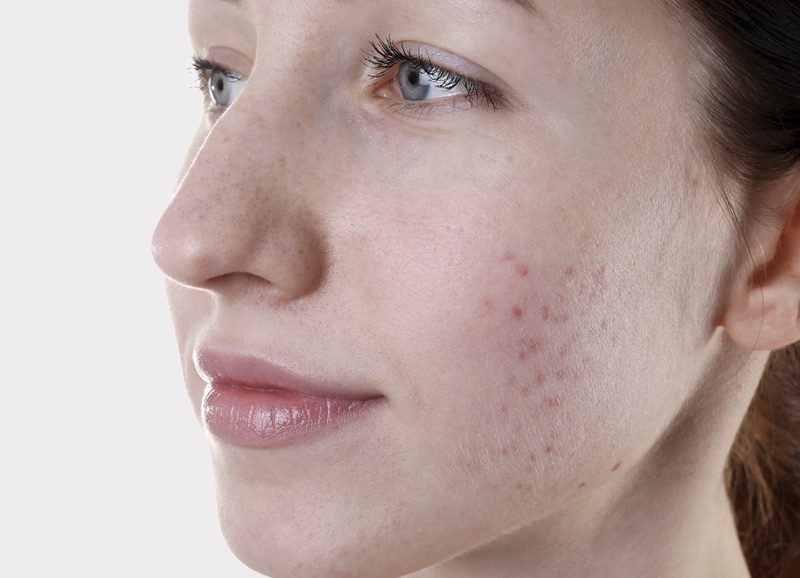
Acne scars: why do acne marks develop?
Acne scars develop when the sebaceous gland becomes inflamed and the surrounding collagen fibres are damaged and replaced by scar tissue containing lower-quality collagen.
There are technologies and treatments that can successfully reduce and improve the appearance of these marks.
–
How can red acne marks be removed?
After acne, red marks may remain as a residual effect of the inflammatory process. They can persist for weeks or months, meaning that even after the spot has disappeared, a red or brown mark may remain.
These red acne marks can be effectively reduced or removed with laser or IPL treatment and, in some cases, with specific topical creams.
Types of acne scars and how to treat them
- Boxcar scars have a wide diameter (more than 2 mm) and clearly defined edges.
- Ice-pick scars: small, deep punctiform scars less than 2 mm in diameter.
- Rolling scars: shallower depressions that affect larger areas and give the skin an uneven, textured appearance.
Treatment differs for each type, although many patients have all three types of acne scar, so we combine treatments.
How can red acne marks be removed?
After acne, red marks may remain as a residual effect of the inflammatory process. They can persist for weeks or months, meaning that even after the spot has disappeared, a red or brown mark may remain.
These red acne marks can be effectively reduced or removed with laser or IPL treatment and, in some cases, with specific topical creams.
Types of acne scars and how to treat them
- Boxcar scars have a wide diameter (more than 2 mm) and clearly defined edges.
- Ice-pick scars: small, deep punctiform scars less than 2 mm in diameter.
- Rolling scars: shallower depressions that affect larger areas and give the skin an uneven, textured appearance.
Treatment differs for each type, although many patients have all three types of acne scar, so we combine treatments.
Before and after acne scars
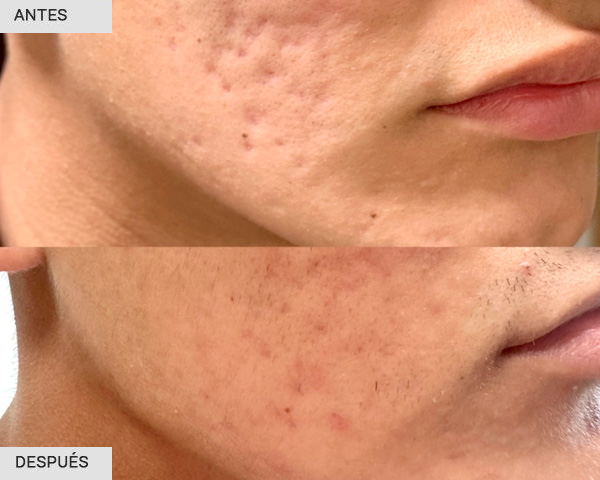
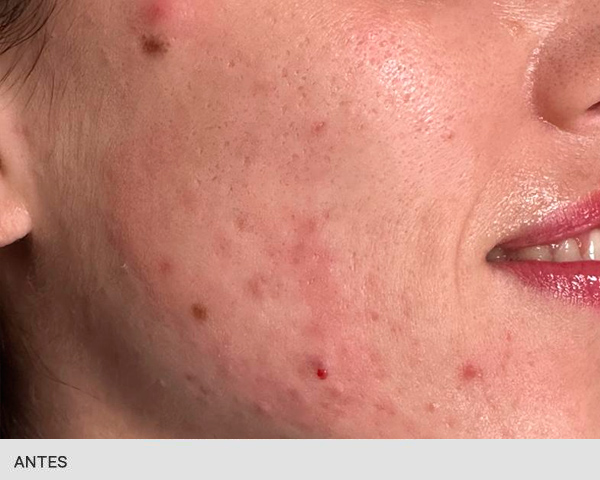
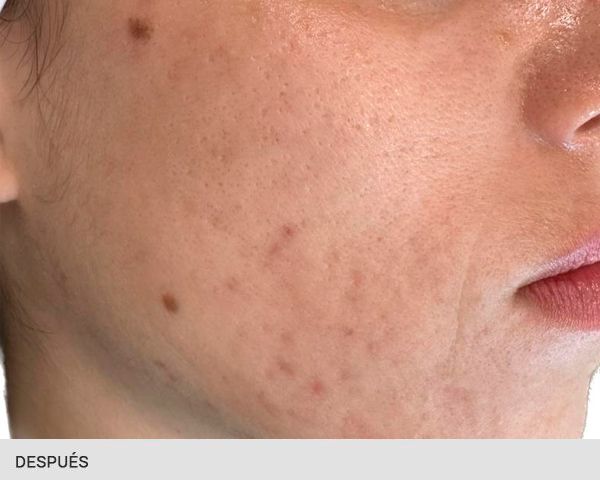
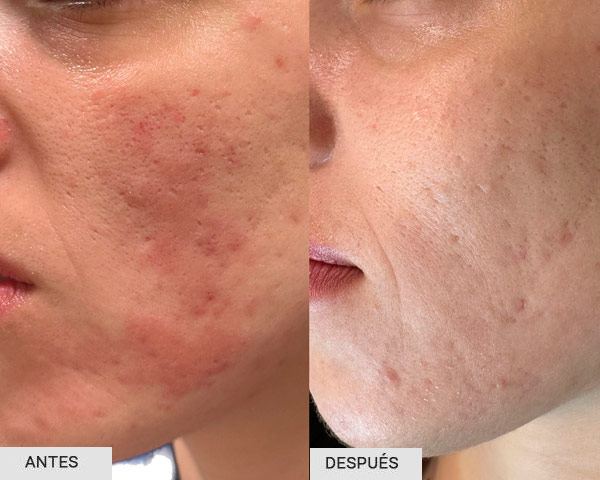
The best technology to reduce or remove acne marks
- Medical consultation to assess the type and severity of acne scarring.
- Personalisation of treatment, which may combine several techniques.
- We treat mild, moderate and deep acne scars.
- We use Fraxel laser, picosecond laser or CO2 laser, depending on the type of acne scar.

Price
Depends on the type and severity of the scars

Sessions
3–5 sessions (1 per month)

Results
Visible from the first session
Request an appointment at Ribe Clinic

Acne scar treatment in Barcelona at Ribe Clinic
Depending on the severity of the acne scar or mark, we use the most appropriate type of laser.
- Mild or moderate acne scars
The best option is the non-ablative fractional Fraxel re-store or Frax laser, which remodels scar collagen and stimulates the formation of new collagen.
–
In addition, the heat from the laser helps to destroy the Propionebacterium Acnes bacteria, thereby reducing the appearance of further acne.
–
Another option is the fractional picosecond laser, indicated for Asian patients and those with higher skin phototypes (darker skin).
- Severe and/or deep acne scars
The ablative fractional CO2 laser heats the tissue to 100°C, breaking down scar collagen, stimulating new collagen formation and causing skin contraction.

How many sessions do I need to reduce acne marks?
The number of sessions needed to remove or improve acne scars and marks depends on the severity of the scarring, the skin type and the results achieved as treatment progresses.
Mild or moderate:
- Fractional Fraxel Re-Store or Frax laser: 3 to 5 sessions, one session every 15–30 days.
- Fractional picosecond laser: 4–6 sessions, one every 2 weeks.
Severe and/or deep:
- Fractional CO2 laser: 2 sessions, one every 3–6 months.

Aftercare
Simply apply a repairing or moisturising cream to the treated area for a few days (7–10 days), together with sun protection (SPF 50+). For deep acne scars and marks, an antibiotic cream and herpes simplex prophylaxis are recommended.
Frequently asked questions
Why Choose Ribe Clinic

Experience and Exclusivity
Dr Adriana Ribé personally conducts consultations and performs the medical treatments.
Medical Safety
Materials and devices with QR codes and CE certification. Scientifically supported protocols.

Patient Follow-up
Follow-up appointments and direct consultations with the doctor regarding the treatments performed.

Sustainable Clinic
The first aesthetic medicine clinic committed to sustainability.